
Net Billing in Pakistan: A Complete Guide to 2026 Solar Policy Shift
The National Electric Power Regulatory Authority (NEPRA) has formally notified the (Prosumer) Regulations, 2026, marking a decisive shift from the decade-old net metering framework to a new net billing system for solar and other renewable energy prosumers. This comprehensive guide analyzes the new regulations, their financial implications, and what they mean for both prospective and existing solar users in Pakistan.
Executive Summary: Net Billing in Pakistan
Effective February 9, 2026, NEPRA has repealed the Net Metering Regulations, 2015 and introduced a net billing model that fundamentally changes how rooftop solar exports are compensated. Under this new framework:
- Export Compensation: Surplus electricity is purchased by distribution companies (Discos) at the national average energy purchase price (approximately Rs11 per unit), rather than the retail tariff.
- Import Billing: Electricity consumed from the grid is billed at the full applicable consumer tariff (Rs37-55 per unit), without the one-to-one offset benefit.
- Transition: Existing net metering prosumers retain their agreements until expiry, after which they will transition to net billing.
- Scope: The regulations apply to clean generation facilities (solar, wind, biogas) up to 1 megawatt (MW) capacity.
The policy aims to address grid stability concerns and cross-subsidization issues arising from rapid rooftop solar adoption, which reached approximately 6,000-7,000 MW of installed capacity.
Net Metering vs. Net Billing: Core Differences Explained
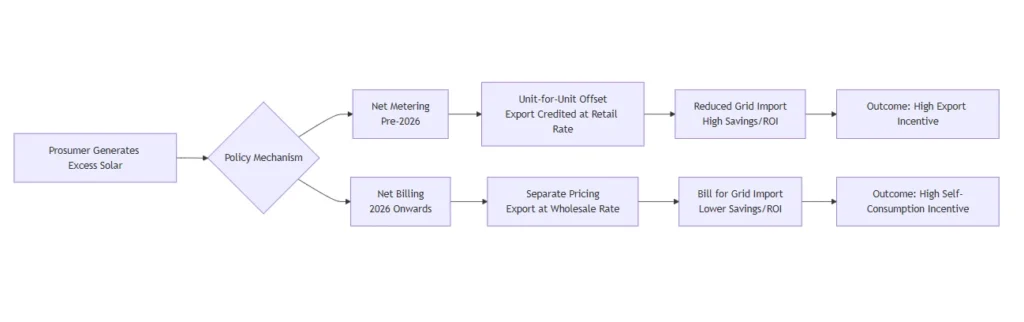
Understanding the shift begins with a clear comparison of the two mechanisms. The change is not merely a terminology update but a fundamental restructuring of financial flows and incentives.
Detailed Comparison Between Net Metering and Net Billing
| Aspect | Net Metering (2015, Repealed) | Net Billing (2026) |
|---|---|---|
| Core Principle | Unit-for-unit offset of imports and exports. | Separate pricing for imports and exports. |
| Export Compensation | Credited at retail tariff rate (approx. Rs25.9/unit). | Purchased at national average energy price (approx. Rs11/unit) |
| Import Billing | Net consumption after offsetting exports. | Billed at full applicable retail tariff (Rs37-55/unit) |
| Contract Term | 7 years. | 5 years, renewable by mutual consent. |
| Financial Outcome | Maximized savings for high-export systems. | Promotes self-consumption; extended payback periods. |
| Grid Impact | Could strain local grids and raise cross-subsidy concerns. | Aims for grid stability and equitable cost distribution. |
Regulatory Overview: The NEPRA (Prosumer) Regulations, 2026
The new regulations establish a comprehensive framework for “prosumers”—consumers who also produce electricity.
Eligibility and Capacity
- Applicable Systems: Solar photovoltaic, wind, and biogas generation facilities.
- Capacity Limit: Up to 1 MW for systems falling under NEPRA’s direct regulatory domain.
- Sanctioned Load: The generation capacity cannot exceed the consumer’s sanctioned load.
Application and Connection Process
The regulations outline a defined, multi-step approval process:
- Application Submission: Interested persons apply to their local distribution company (licensee).
- Acknowledgement: The licensee must acknowledge receipt within 5 days and provide free guidance and application documents.
- Technical Review: The licensee conducts a technical assessment (up to 15 days) to ensure safe grid interconnection. For systems ≥250 kW, a load flow study is required.
- NEPRA Concurrence: After interconnection agreement approval, NEPRA grants formal concurrence within 7 days.
- Interconnection Installation: The consumer installs the interconnection facility, including metering, within 15 days of payment completion.
Technical and Safety Standards
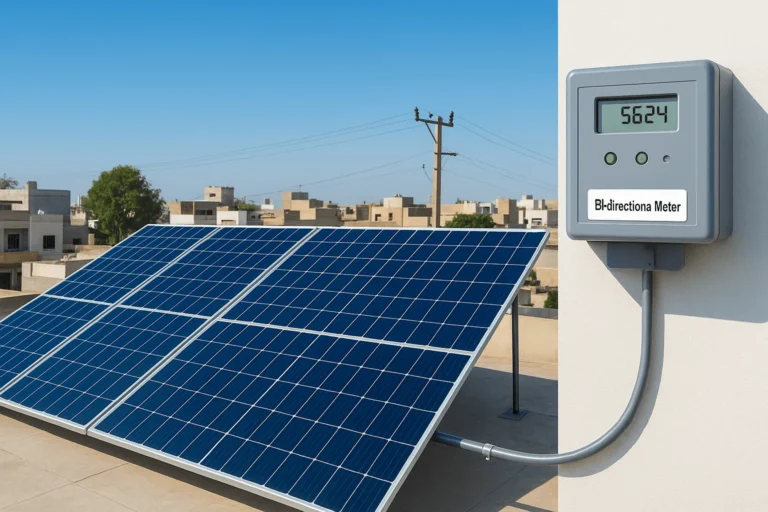
- Metering: Must accurately measure electricity flow in both directions. Two separate meters can be used if the calculation is equivalent to a single meter.
- Grid Safety: Prosumers must comply with voltage and frequency limits and install protective equipment, including disconnect switches for emergency isolation. The licensee may disconnect systems that pose safety risks.
Financial Impact and Return on Investment (ROI) Analysis
The shift to net billing significantly alters the economics of rooftop solar investments.
The Changed Financial Equation
Under net metering, a unit exported to the grid was valued the same as a unit imported, providing a powerful financial hedge against high tariffs. Under net billing, that export is now valued at a much lower wholesale rate, fundamentally changing the savings calculus.
- Reduced Export Value: The buyback rate has been slashed from around Rs25.9 per unit to approximately Rs8.13-11 per unit.
- Increased Import Cost: Grid electricity is now billed at full slab rates, which are typically higher than the average export credit.
- Extended Payback Period: The return on investment for solar systems designed primarily for export will lengthen from the typical 3-5 years to potentially 5-8 years or more.
The New Imperative: Self-Consumption
The regulations create a strong financial incentive for self-consumption—using the solar power as it is generated. The value of a solar unit consumed directly (avoiding grid import at Rs37-55/unit) far exceeds the value of the same unit exported (Rs11/unit).
⚠️ Critical Insight: The new model favors systems sized to match daytime load profiles (homes, offices, factories) rather than oversized systems designed primarily for export. Battery storage to store excess daytime power for nighttime use becomes a more attractive financial proposition.
Transition Rules: What Existing Prosumers Must Know
The policy change has created significant uncertainty for existing solar users. Key transition points include:
- Grandfathering Clause: Existing prosumers with valid net metering contracts will continue under the old terms until their agreements expire.
- Post-Expiry Shift: Upon contract expiration, these users will transition to the net billing framework.
- PM’s Intervention: Prime Minister Shehbaz Sharif has taken notice of the backlash and ordered a review to protect existing solar users, creating a potential for amendments.
- No Immediate Shift for Existing Users: Contrary to initial reports, existing prosumers will not be immediately shifted to net billing.
Reasons for the Policy Shift
The transition was driven by a confluence of factors threatening the financial health of the power sector and grid stability:
- Rapid Capacity Growth: Rooftop solar capacity reached approximately 6,000-7,000 MW facebook , leading to significant reductions in Disco sales.
- Revenue Erosion: The Power Planning and Monitoring Company estimated a loss of 3.2 billion units and Rs101 billion in revenue for distribution companies in FY2024.
- Cross-Subsidy Burden: The financial burden was being passed on to non-solar consumers through tariff increases (approx. Rs0.9/unit)
- Grid Stability Concerns: Unmanaged export growth could lead to local grid overloads and frequency issues.
- Equity Considerations: The benefits of net metering were perceived as disproportionately flowing to higher-income households.
Battery Storage: A Strategic Response to Net Billing
With the financial incentive for grid export diminished, hybrid solar systems with battery storage become increasingly viable. This setup allows prosumers to:
- Store excess daytime solar energy.
- Use the stored power during evening peak hours when grid tariffs are highest.
- Maximize the value of every solar unit by displacing expensive imported grid electricity.
While the upfront cost increases, the payback period can be shorter than relying on low-value grid exports under the new framework.
How to Apply for a New Prosumer Net Billing Agreement
The application process, though formalized, is designed to be systematic
Required Steps:
- Engage a Licensed Installer: Choose a reputable solar vendor familiar with NEPRA regulations.
- Submit Application to Disco: Provide necessary documents (CNIC, ownership proof, site plan, system design) to your local distribution company (e.g., LESCO, IESCO, K-Electric).
- Await Technical Review: The Disco will assess grid capacity and safety standards.
- Obtain NEPRA Concurrence: After Disco approval, the case is sent to NEPRA for final clearance.
- Install and Commission: Install the metering and interconnection equipment as per standards.
Conclusion:
NEPRA’s 2026 regulations represent a paradigm shift in Pakistan’s distributed energy policy, prioritizing grid stability and equitable cost distribution over rapid, subsidized rooftop solar growth. While the new net billing framework extends payback periods for export-focused systems, it makes solar economically viable for consumers with significant daytime loads and could spur a market for energy storage solutions.
The policy landscape remains dynamic. The Prime Minister’s intervention indicates that further adjustments to protect existing users are possible.. Prospective solar investors must now carefully size their systems for self-consumption and explore hybrid solutions to maximize financial returns under the new rules. The era of simple, one-to-one net metering is over, replaced by a more nuanced grid partnership that demands strategic energy management from every consumer.